

London, Paris, Dubai: Three Global Cities, Three Very Different Investment Stories in 2026
We speak to international real estate investors every single week, and the exact same comparison keeps coming up like clockwork. Whether managing a private family office or planning a personal cross-border diversification strategy, investors are constantly benchmarking the world’s most high-profile real estate markets against one another.
In 2026, the global property landscape has split into distinctly different regimes. This isn’t a promotional post; these are the cold, hard numbers. Here is a transparent look at the operational data behind London, Paris, and Dubai so you can draw your own conclusions.
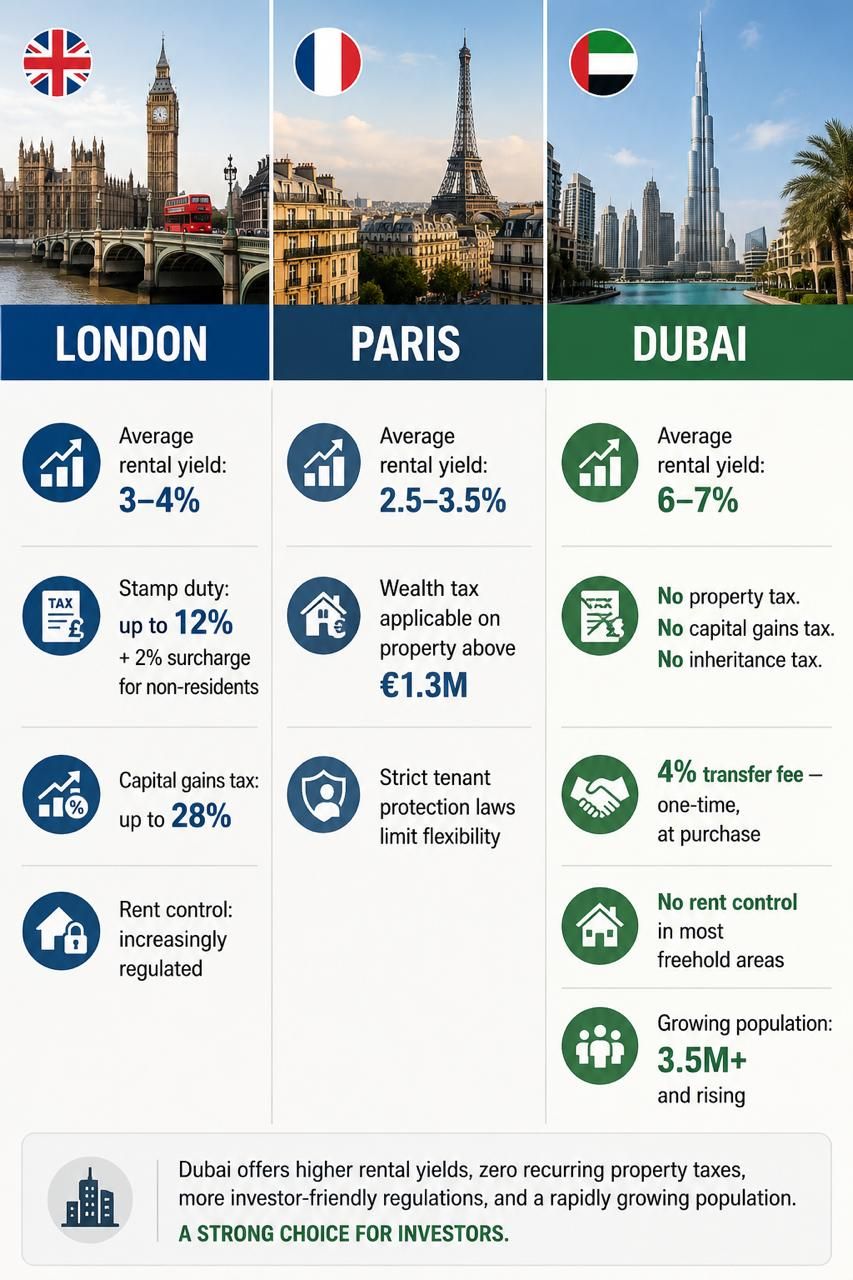
The Data at a Glance
| Investment Metric | 🇬🇧 London | 🇫🇷 Paris | 🇦🇪 Dubai |
| Average Rental Yield | 3.0% – 4.0% | 2.5% – 3.5% | 6.0% – 7.0% |
| Transaction Fees | Up to 12% Stamp Duty (+2% non-resident surcharge) | ~7.0% – 8.0% Notary & registration fees | 4.0% Transfer Fee (One-time, at purchase) |
| Taxation on Gains | Capital gains tax up to 28% | Wealth tax applicable above €1.3M | No property, capital gains, or inheritance tax |
| Regulatory Environment | Increasingly regulated rental laws | Strict, long-term tenant protection laws | No rent control in most freehold areas |
| Demographic Tailwind | Steady baseline growth | Mature, stable population | 3.5M+ and rising sharply |
🇬🇧 London: The Institutional Safe Haven Under Friction
London has long been considered a primary “safe haven” asset class for global wealth. However, entering 2026, the friction costs of moving capital into the UK capital have grown significantly heavier:
- Yield Compression: Average rental yields have compressed to the 3–4% range. When accounting for management fees and maintenance, net cash flow is minimal.
- Aggressive Entry Barriers: Stamp duty land tax can scale up to 12%, and international investors face an additional 2% non-resident surcharge, meaning a massive chunk of initial capital is lost immediately at purchase.
- Fiscal Drag: Capital gains taxes reaching up to 28% eat into the backend exit strategy, while a heavily regulated rental market limits operational flexibility.
🇫🇷 Paris: High-Prestige, Low-Velocity Real Estate
Paris offers unmatched cultural prestige and historic wealth preservation, but the financial architecture is restrictive for investors prioritizing yield optimization:
- The Yield Floor: Yields in Paris are among the lowest of any premier global city, averaging between 2.5% and 3.5%.
- The Fiscal Threshold: Real estate portfolios valued above €1.3 million trigger France’s structural wealth tax (IFI), imposing recurring carrying costs simply for holding the asset.
- Protective Legalities: Highly rigid tenant protection laws make managing tenancies a complex legal exercise, reducing liquidity and minimizing a landlord’s operational agility.
🇦🇪 Dubai: Fiscal Efficiency & Growth Momentum
Dubai continues to operate on an entirely different economic playbook, moving from a cyclical speculative playground to a fundamentally sound, income-generating powerhouse:
- Unmatched Yields: Healthy economic growth and corporate inbound migration sustain strong net rental yields between 6% and 7%.
- Absolute Tax Efficiency: The headline driver remains the fiscal framework—0% property tax, 0% capital gains tax, and 0% inheritance tax. The transaction friction is simplified down to a one-time, 4% transfer fee.
- Market Mechanics: Landlords retain control. Freehold areas largely operate without restrictive rent ceilings, allowing asset values and rental income to track naturally with organic population growth, which has breezed past 3.5 million.
An Honest Assessment of the Risks
No market is entirely without risk, and professional asset management requires looking at both sides of the ledger. While Dubai’s fundamentals explain exactly why it continues to attract historic waves of global capital, investors must monitor localized risk parameters:
- Oversupply: High development volumes mean sub-market selection is critical; certain areas face rental pressure due to localized incoming supply.
- Regulatory Upgrades: As the market matures, regulatory frameworks are constantly adapting.
- Currency Dynamics: The UAE Dirham (AED) remains pegged to the US Dollar (USD). This heavily shields investors against the hyper-volatility seen in other global currencies, though it hitches macroeconomic cycles tightly to US Federal Reserve monetary decisions.
Recent Posts
London, Paris, Dubai: Three Global Cities, Three Very Different Investment Stories in 2026
Business Bay vs. Downtown Dubai: Two Neighborhoods